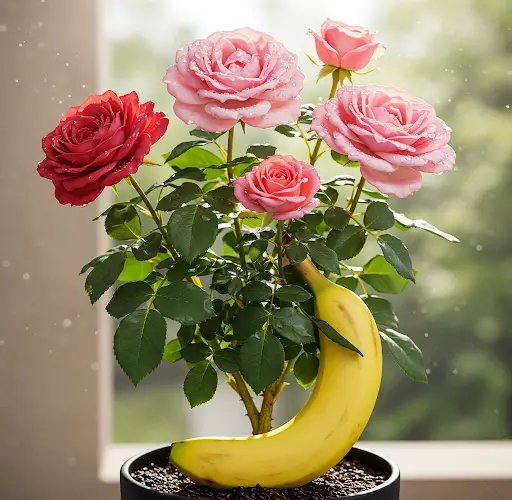
Roses are beloved for their beauty and fragrance, and propagating them from cuttings is a rewarding way to multiply your garden. While many people rely on commercial rooting hormones, there’s an effective and fully natural alternative you can use from your kitchen: bananas.
Yes, bananas—not only are they packed with nutrients, but they also offer the perfect environment for rose cuttings to take root quickly and successfully. This simple, organic method works by leveraging the banana’s moisture, minerals, and natural enzymes to create the ideal rooting conditions. With the right technique, you can increase your success rate dramatically—some gardeners even report nearly 100% rooting success using this approach.
Let’s explore how to use bananas to root rose cuttings effectively, step by step.
Why Bananas Help Rose Cuttings Root
Bananas are not only nutritious for people—they also benefit plants in several ways:
-
Rich in Potassium and Phosphorus: These minerals support root development and early plant growth.
-
Natural Enzymes: Bananas contain growth-promoting enzymes that stimulate cell activity in plant cuttings.
-
Moisture Retention: The soft flesh of the banana helps maintain consistent moisture levels, which is essential during the rooting stage.
-
Organic Medium: A banana acts as a natural “container” for the cutting, holding nutrients right where the roots are developing.
Used properly, bananas can act as both a rooting stimulant and a nutrient source for young plants.
Materials You’ll Need
-
A ripe (but not overripe) banana
-
Healthy rose cuttings (6–8 inches long, preferably semi-hardwood)
-
Sharp scissors or pruning shears
-
Planting container or pot with drainage holes
-
Potting mix or a mix of sand and soil
-
Plastic wrap, a plastic bottle, or a clear bag (for humidity)
-
Spray bottle with clean water
Step-by-Step: Rooting Rose Cuttings Using Banana
1. Choose and Prepare the Rose Cuttings
Select healthy rose stems that are free of disease and pests. Semi-hardwood cuttings—those that are not too green or too woody—offer the best results.
-
Cut stems about 6 to 8 inches long, each with 2–3 nodes (leaf joints).
-
Remove all flowers and buds to prevent the cutting from wasting energy.
-
Strip the leaves from the lower part of the cutting, leaving a couple at the top.
Use sterilized pruning shears to make a clean, angled cut just below a node—this is where root development will begin.
2. Prepare the Banana
Cut a banana into chunks about 1.5 to 2 inches long. Use a knife to make a small hole in the center of each chunk, deep enough to insert the base of a rose cutting.
Be careful not to split the banana completely—the goal is to create a snug opening that will hold the stem securely.
3. Insert the Cuttings
Insert the base of each cutting into the banana chunk. Make sure the bottom node (the point where roots will form) is embedded in the banana flesh.
This creates a moist, nutrient-rich environment that supports root formation from day one.
4. Plant the Banana-Cutting Combination
Fill your pot or planting container with well-draining soil—ideally a mix of potting soil and sand or perlite. This provides a loose medium for air circulation and root expansion.
Bury the banana and the cutting together into the soil so that the banana is completely covered. The rose cutting should remain upright, with at least one node above the soil surface.
Gently press the soil around the base to stabilize the cutting.
5. Create a Mini Greenhouse
To maintain high humidity—essential for rooting success—cover the pot with a clear plastic bag, a plastic dome, or a cut plastic bottle. This traps moisture and warmth while still allowing some airflow.
Place the pot in a bright, warm location that receives indirect sunlight. Avoid direct sunlight, which can overheat the cutting and dry it out.
Care and Monitoring
Check daily to ensure the soil remains moist but not soggy. Mist lightly with water if the surface begins to dry out. Ventilate the plastic covering every day or two to prevent mold buildup.
After 2 to 3 weeks, check for signs of rooting. If the cutting resists a gentle tug, roots are likely forming.
By week four, you may notice new leaf growth, indicating successful rooting and the beginning of active plant development.
Transplanting
Once the cutting has rooted well and begun to grow new leaves, it’s time to transplant it to a larger pot or directly into the garden.
Remove the cutting gently to avoid damaging the fragile roots. You’ll likely see that the banana has partially decomposed and integrated into the soil—this is beneficial and adds continued nutrients.
Plant the rose cutting in nutrient-rich soil and water it thoroughly. Gradually acclimate it to full sun over the next week or two.
Tips for Success
-
Use only ripe bananas—green bananas lack the softness and enzymatic activity needed.
-
Always use clean tools to prevent disease.
-
Avoid overwatering—too much moisture can cause the banana to rot before roots form.
-
Be patient—some cuttings may take slightly longer to establish.
Final Thoughts
Using bananas to root rose cuttings is an eco-friendly and highly effective method. It’s simple, inexpensive, and harnesses nature’s own tools to stimulate plant growth. Whether you’re expanding your garden or preserving a favorite variety, this technique offers a reliable way to grow strong, healthy roses from cuttings.
Give it a try, and watch your roses take root—naturally and beautifully.


