Among the many clever household tips passed down from our grandmothers, one of the most surprising is placing salt on the window sill. At first, it might sound strange — after all, salt belongs in the kitchen, not on your windows. But this age-old practice actually serves a variety of useful purposes that go far beyond seasoning your meals. Curious to learn why? Let’s dive into the history, meaning, and practical uses of salt on the window sill.
The Ancient Importance of Salt
Salt has been part of human civilization since the dawn of agriculture, around 10,000 years ago. During the Neolithic era, when people began settling and farming, salt became essential — not just for enhancing flavor but primarily for preserving food. Before the invention of refrigeration, salt was one of the only ways to keep meat, fish, and vegetables from spoiling.
Because of its vital role, salt was so valuable that it was often called “white gold.” It played a crucial part in trade between early cultures and nations. In fact, the word “salary” comes from the Latin “salarium,” which means “payment in salt.” Roman soldiers were often compensated with portions of salt — a sign of just how important it was.
Over time, salt became a universal household staple. Every home has it, and every kitchen uses it daily. While too much salt can harm our health, in moderation it is indispensable — both as a dietary element and as a practical household helper. And that’s where the story of salt on the window sill begins.
Beyond the Kitchen: Salt’s Surprising Household Uses
We all know salt enhances the flavor of our food. A dish without it is often described as bland or “missing something.” But salt’s usefulness extends far beyond cooking. Its natural properties — absorbent, antibacterial, and purifying — make it a powerful ally for cleaning, deodorizing, and even protecting the home from unwanted pests.
Salt has long been associated with purity and protection. Ancient cultures used it to ward off evil spirits, cleanse spaces, and bring good luck. Even today, many traditions still view salt as a substance that absorbs negative energy. That’s why some people place a bowl of salt in a room or scatter a few grains near the entrance to “purify” the space.
So, putting salt on a window sill isn’t just superstition — it’s a practical trick with real benefits.
Why Put Salt on the Window Sill?
While folklore attributes mystical powers to salt, the real reason for placing it on the window sill is refreshingly down-to-earth: it helps keep ants and other small insects away.
Every year, especially during warm months, ants invade homes in search of food. These tiny, tireless creatures can be fascinating to watch outdoors — marching in perfect lines, carrying crumbs and seeds back to their colony. But when they find their way into our kitchens, fascination quickly turns into frustration.
Ants are incredibly persistent. Once they discover a food source, they leave a trail of pheromones for others to follow. Soon enough, you can have a whole army marching across your countertop or window sill. That’s where the salt trick comes in handy.
Salt: A Natural Ant Repellent
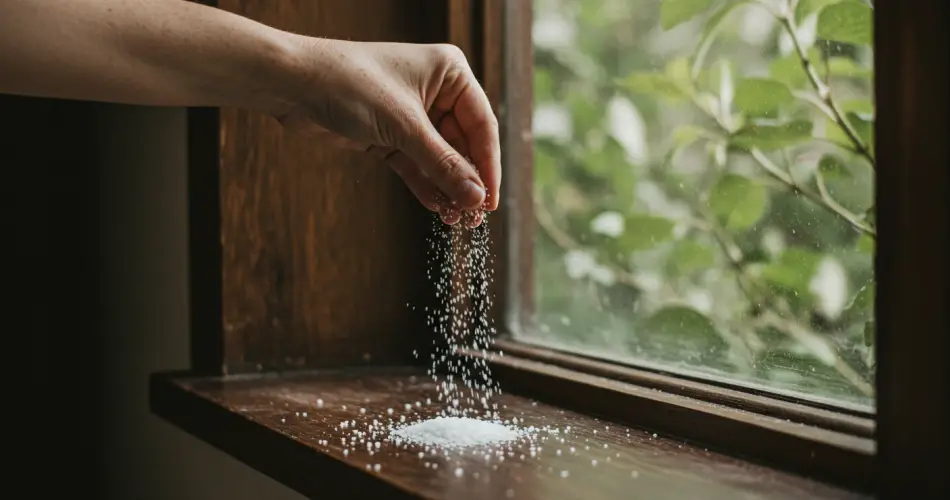
Sprinkling coarse salt along the edges of window sills, door frames, or any other entry points creates a natural barrier that ants dislike crossing. Salt dehydrates their bodies and interferes with their scent trails, confusing them and driving them away.
Unlike chemical insecticides or sprays, salt is completely natural, non-toxic, and safe to use around pets and children. It’s also cheap and always available in the kitchen. All you need to do is sprinkle a generous line of coarse salt where you’ve noticed ant activity — around the windows, under the doors, or near their entry points.
In just a short time, you’ll notice that the ants avoid those areas altogether. It’s one of those simple “grandma tricks” that actually work — an eco-friendly solution that doesn’t require harsh chemicals or expensive pest-control products.
Other Hidden Benefits of Salt Indoors
The magic of salt doesn’t stop at keeping ants away. Its natural ability to absorb moisture makes it an excellent ally against dampness and mold. If your home tends to be humid — especially in areas like the kitchen, bathroom, or bedroom — placing a bowl or small bag of coarse salt on the window sill can help reduce excess moisture in the air.
This helps prevent mold growth and keeps the space feeling fresh and dry. Over time, you’ll notice that the salt clumps up — a clear sign that it’s been absorbing humidity. When that happens, just replace it with a new batch.
Salt also works well inside pantries and cupboards, where it keeps away not only ants but also pantry moths and small insects that love to feed on flour, pasta, or cereals. Just place a few tablespoons of coarse salt in a small open container or sachet, and set it on a shelf. You can even add a few bay leaves for extra protection and a pleasant aroma.
And if you’ve ever seen a stray insect under the bed or in a closet, a handful of salt in a small dish placed discreetly in those spots can help keep them away while also absorbing any musty odors or excess humidity.
A Timeless Household Ally
So, what once might have sounded like superstition — putting salt on your window sill — turns out to be a practical and time-tested method to maintain a cleaner, fresher, and insect-free home. It’s simple, natural, and costs practically nothing.
Our grandmothers may not have had today’s range of cleaning products or insect repellents, but they knew how to use what they had — and salt was one of their most trusted tools.
Next time you notice ants creeping along your window or feel that your home is a bit too humid, remember this humble kitchen ingredient. A pinch of salt might just be all you need to restore freshness, balance, and peace to your home — just as it did in generations past.