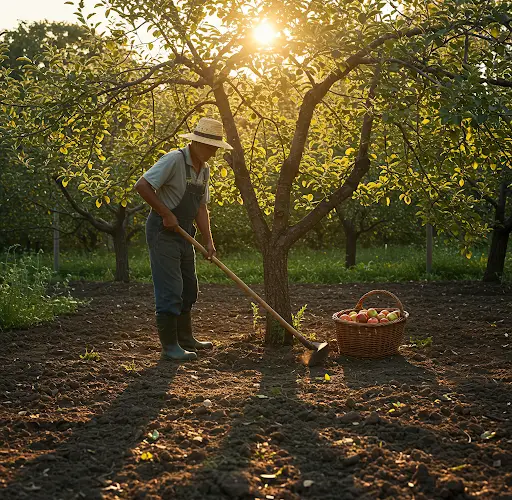
One of the essential tasks in maintaining a healthy and productive orchard is regularly removing grass around fruit trees and berry bushes while also fertilizing the soil with organic matter in the fall. This practice offers several benefits, ensuring optimal growth and development of fruit trees. In this article, we will discuss why grass removal is necessary, how to fertilize effectively, and additional methods to improve soil health and fruit tree growth.
Why Is It Important to Remove Grass Around Fruit Trees?
Grass acts as a competitor for nutrients, water, and space. When grass grows around a fruit tree, it absorbs valuable nutrients from the soil, limiting the tree’s ability to grow and develop properly. As a result, the fruit tree may experience stunted growth and reduced fruit production.
A simple experiment can prove this point. If you plant two identical fruit tree seedlings in separate areas—one where the grass is regularly removed and another where the grass is left to grow—you will notice a significant difference in their growth over time. The seedling in the grass-free zone will thrive, growing almost twice as fast as the one surrounded by grass, which will struggle due to competition for resources.
For the best results, completely clear the grass around the tree and create a mulch bed with organic materials such as hay or fallen leaves. This not only reduces competition but also provides additional benefits to the soil and tree health.
Protection Against Mechanical Damage
Another crucial reason to remove grass is to prevent damage to the tree during mowing. When using a string trimmer or mower near fruit trees, accidental contact with the tree trunk can cause serious harm. Damaged bark creates an entry point for pathogens and pests, compromising the tree’s health and potentially leading to disease or decay.
By clearing the grass around the tree, you eliminate the need to mow close to the trunk, thus reducing the risk of accidental injury. This proactive step ensures the long-term health of your orchard.
Preventing Soil Compaction and Erosion
Leaving the area around fruit trees bare after grass removal is not recommended, as exposed soil can lead to compaction and erosion. Rain, wind, and temperature fluctuations can degrade the quality of the soil over time, reducing its fertility and making it harder for trees to absorb nutrients.
A natural solution is to use fallen leaves as mulch. In nature, fruit trees naturally shed leaves in the fall, creating a protective layer that suppresses grass growth while gradually decomposing and enriching the soil. However, this method is most effective for mature trees with a significant amount of foliage. For younger trees with fewer leaves, additional mulching with hay or organic compost can help replicate this process.
If the fruit tree has been affected by disease, do not use the fallen leaves as mulch, as this can spread infections. Instead, remove and dispose of infected leaves properly to maintain orchard health.
Fertilizing Fruit Trees After Grass Removal
Once the grass has been cleared, the next step is fertilization. Providing organic nutrients helps support the tree’s growth, improves fruit production, and enhances soil fertility.
Organic fertilizers, such as compost, well-rotted manure, and specially formulated fruit tree fertilizers, are excellent choices. Many organic fertilizers come in granular or pellet form and are available in garden stores at affordable prices.
To apply fertilizer:
- After removing the grass, create shallow trenches around the base of the tree using a hoe.
- Sprinkle the organic fertilizer evenly within the trenches.
- Gently cover the fertilizer with soil to ensure it integrates well into the ground.
By following this process, nutrients will gradually release into the soil, providing sustained nourishment to the tree. Fertilization in the fall is particularly beneficial as it prepares the tree for winter dormancy and promotes strong growth in the spring.
Additional Planting Techniques for Orchard Health
In addition to grass removal and fertilization, planting companion plants around fruit trees can provide further benefits. Certain flowers and herbs naturally enhance soil quality, deter pests, and improve fruit flavors.
- Daffodils:
- Planting daffodil bulbs around fruit trees may help deter voles, which often damage tree roots. Their scent and slight toxicity can repel these pests.
- While this method is still being tested, daffodils are a beautiful addition to any orchard and provide aesthetic value.
- Spring Bulbs and Ground Covers:
- Spring-blooming bulbs, such as tulips and crocuses, can suppress grass growth before fruit trees develop their leafy canopies.
- Clovers serve as a permanent ground cover, preventing erosion while naturally enriching the soil with nitrogen, a vital nutrient for tree growth.
- Herbs for Pest Control and Flavor Enhancement:
- Planting mint, lemon balm, sage, oregano, and thyme around fruit trees may help deter pests and improve fruit taste.
- Lemon balm, in particular, is thought to protect peach and nectarine trees from fungal diseases such as leaf curl.
- Marigolds and Calendula:
- These flowers naturally repel nematodes and other soil-dwelling pests.
- Their bright blooms add beauty to the orchard while serving a functional purpose in pest control.
Conclusion
Maintaining a healthy orchard requires consistent effort, and removing grass around fruit trees is one of the most beneficial practices. By eliminating competition for nutrients, reducing mowing damage, preventing soil erosion, and implementing organic fertilization methods, you can significantly improve tree growth and fruit production.
Additionally, incorporating companion planting strategies enhances soil fertility, deters pests, and contributes to a thriving ecosystem in your orchard. Whether you are a beginner or an experienced fruit grower, following these steps will help ensure the long-term success of your orchard.


