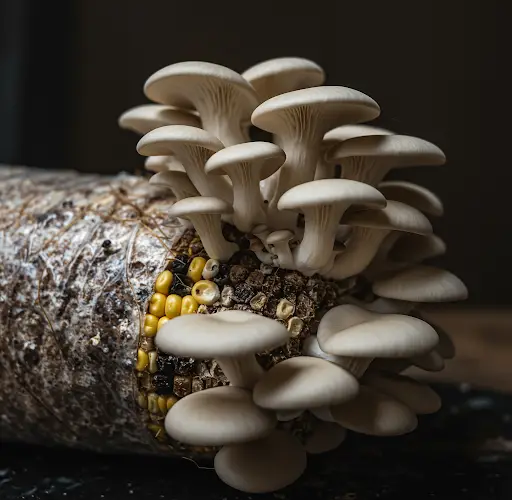
Mushroom cultivation is often viewed as a delicate or advanced gardening practice, but with the right technique and a little creativity, it can become an easy, low-cost venture. One of the most surprising and effective methods involves using something most people throw away—corn cobs. Passed down through generations, this traditional method is both simple and sustainable, making it ideal for home gardeners looking to grow delicious mushrooms with minimal effort.
This method produces white, fragrant mushrooms that thrive on the nutrients left in discarded corn cobs. It’s proof that food waste can be transformed into something incredibly valuable with a bit of knowledge and care.
Why Corn Cobs?
Corn cobs may seem like useless leftovers, but they’re rich in cellulose and other organic compounds that certain fungi love. When properly prepared, these fibrous cores provide a perfect growing medium for white oyster mushrooms or other common edible varieties.
Unlike straw or sawdust, which often require sterilization, corn cobs are denser and slower to break down. This makes them an ideal substrate for slower-growing mushrooms while offering a more sustained release of nutrients.
In short, corn cobs are an excellent, cost-free alternative that allows gardeners to repurpose kitchen scraps while producing a high-value food.
Getting Started: What You’ll Need
To grow mushrooms using this traditional method, gather the following materials:
-
Used corn cobs (clean and free of mold)
-
Mushroom spawn (preferably oyster or other white mushrooms)
-
A container or growing bag (buckets, baskets, or perforated plastic bags)
-
Clean water
-
Optional: Banana leaves or burlap cloth for covering
No high-tech tools are needed. With a few household items and a shaded spot, you can create a productive mushroom-growing setup at home.
Preparing the Corn Cobs
-
Clean the cobs:
Rinse the used corn cobs thoroughly to remove any food residue or contaminants. If possible, boil them in water for 30–60 minutes to reduce harmful microbes. Allow the cobs to cool and drain completely. -
Chop or leave whole:
For faster colonization, break the cobs into smaller chunks. However, whole cobs can also work if space allows. -
Soak overnight:
Soak the cobs in clean water for 12–16 hours. This step is crucial to ensure the substrate retains enough moisture for mushroom mycelium to grow.
Inoculating with Mushroom Spawn
-
Layering technique:
Place a few corn cobs at the bottom of your container or bag. Sprinkle mushroom spawn evenly over them. Add another layer of cobs and spawn, and repeat until full. Gently press each layer to compact slightly, but avoid over-packing. -
Cover and incubate:
Cover the container with banana leaves, burlap, or a breathable fabric. Place it in a dark, humid spot with good airflow—under a tree, on a shaded porch, or in a shed. -
Wait and monitor:
Within 10–14 days, you should see white mycelium spreading across the cobs. Keep the setup moist by misting lightly once or twice a day. Avoid direct sunlight and ensure the temperature stays between 20°C to 28°C (68°F to 82°F).
Harvesting the Mushrooms
Once the cobs are fully colonized—usually within three weeks—tiny mushroom pins will begin to emerge. In a few days, these will develop into full-sized, white, aromatic mushrooms ready for harvest.
Harvest them just before the caps fully flatten out for the best texture and flavor. Use a clean knife or twist gently at the base to remove them.
Each setup can yield several flushes. After harvesting, continue misting and maintaining the setup, and you may enjoy another 2–3 rounds of mushrooms over the next few weeks.
Tips for Success
-
Avoid contamination: Keep hands and tools clean during each step to minimize the risk of mold or bacterial growth.
-
Use fresh spawn: Make sure your mushroom spawn is fresh and from a reliable source.
-
Maintain humidity: Dry conditions will halt growth. Keep the environment humid with misting or by covering the setup with breathable material that retains moisture.
-
Recycle again: After mushroom production ends, the used corn cobs can be composted or added to garden beds as mulch.
A Sustainable, Family-Proven Method
This mushroom-growing method has stood the test of time—handed down through generations as a practical way to make use of what would otherwise be discarded. It blends sustainability with simplicity and brings food production into even the smallest backyard or balcony.
What’s most rewarding is not just the harvest, but the sense of reconnection to age-old practices that respect nature’s cycles. With a bit of patience and care, anyone can replicate this technique and enjoy homegrown mushrooms without expensive tools or commercial kits.
Next time you enjoy a meal of corn on the cob, save those cores—you might just be holding the key to your next delicious harvest.


