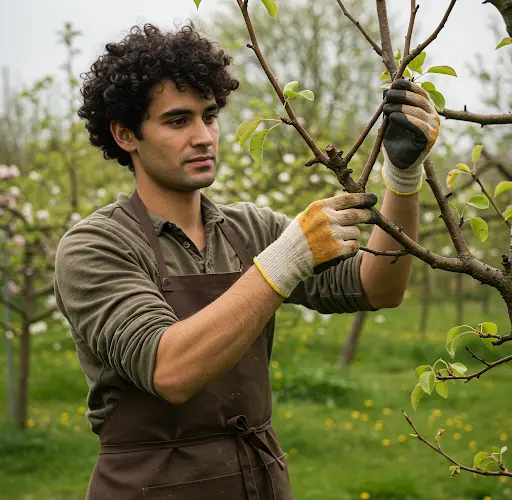
Pruning fruit trees and properly shaping their growth structure is one of the most essential practices in fruit cultivation. The primary objective of pruning is to establish a well-formed canopy, promote early fruiting, optimize fertility, and improve the quality of the fruit. Achieving the correct crown formation involves careful branch bending, strategic pruning, and green pruning techniques conducted during the growing season.
Importance of Proper Branch Bending
Branch bending is best performed during the initial years following the planting of a fruit tree. This measure is particularly crucial for species such as apple, pear, plum, cherry, apricot, and peach, where a well-structured canopy ensures optimal fruit production. If you are interested in learning more about fruit cultivation, explore additional materials on our platform and share this knowledge with fellow growers. Your support, through likes, comments, and subscriptions, helps us continue providing valuable agricultural education.
Controlling Growth in the Early Years
After planting an orchard, whether on a large or small scale, shaping the fruit tree’s canopy during its early years is essential. Growth must be regulated to encourage lateral expansion rather than excessive vertical growth. While this can be labor-intensive initially, proper pruning and branch bending ensure that subsequent maintenance becomes easier. A well-formed tree will not only produce more fruit but will also be structurally sound and resistant to environmental stressors.
Implementation of Pruning and Bending Techniques
Branch bending is a fundamental technique in high-density orchards and intensive fruit production. It should be conducted consistently from the time of planting until the tree reaches its desired form. This practice is also beneficial for maintaining an established growth structure and rejuvenating older fruit trees.
Branches chosen for canopy formation should be bent at an angle of 65-75° relative to the trunk. Using specialized branch benders is the most effective way to ensure proper positioning and avoid common mistakes, such as excessive arching of branches. When branches bend in an arch, growth becomes uneven, water sprouts appear at the bending points, and the crown develops irregularly.
Traditional vs. Modern Bending Methods
Historically, branch bending was achieved by tying branches with twine, raffia, or wooden slats, or by hanging weights. However, these methods have several drawbacks:
- They require considerable labor and time investment.
- The materials used for tying can cut into branches or the tree trunk, causing wounds that make the plant susceptible to disease and pests.
- Improvised tensioners can obstruct other necessary horticultural activities during the growing season.
Specialized branch benders offer a practical solution. These tools are easy to install, require less manual labor, and are reusable for many years. Additionally, they provide more precise control over branch placement, preventing structural weaknesses in the tree while facilitating essential agricultural tasks.
Consequences of Neglecting Branch Bending
If branch bending is not implemented in the early years of a tree’s growth, the tree may suffer from structural problems later. Unmanaged branches are more likely to break under the weight of fruit, strong winds, or heavy storms. Correcting this issue in later years is challenging because mature branches become thicker, more rigid, and prone to breaking when force is applied.
How to Properly Use Branch Benders
After planting a fruit tree and trimming its top and outer branches, you can begin bending one-year-old branches immediately. The process involves placing a branch bender on the tree, securing the selected branch, and holding it in the desired position for approximately three weeks. Once the branch is set, the bender can be repositioned to another branch, repeating the process as necessary.
Branch benders can remain in place until a new branch emerges from the tree. The entire bending process for a single branch takes just a few seconds, making it significantly faster and more efficient than traditional methods. These benders have four adjustable positions and varying degrees of tension, allowing growers to customize the bending force based on the tree’s needs. They should be used from early spring through late summer and removed in September for reuse the following season.
DIY Alternatives to Commercial Benders
For small-scale fruit growers who cannot obtain commercial branch benders, simple alternatives can be made using metal wire. By bending the wire into the appropriate shape, you can create an effective branch bender at minimal cost.
Understanding Branch Angles and Their Impact on Growth
The angle at which a branch grows significantly affects its development and fruiting potential:
- Upright branches grow rapidly in height but have fewer lateral shoots, resulting in lower fertility.
- Horizontally growing branches exhibit reduced elongation but develop numerous lateral buds, leading to higher fruit production.
- Branches bent at angles exceeding 90° produce abundant fruit but tend to weaken over time, making them more prone to dieback.
To balance growth and productivity, the optimal bending angle should be around 70° from the tree’s vertical axis.
Conclusion
Proper pruning and branch bending techniques are essential for cultivating healthy, high-yielding fruit trees. By implementing these practices early and consistently, growers can ensure strong tree structure, prevent branch breakage, and optimize fruit quality. Whether using specialized benders or DIY alternatives, understanding the correct angles and positioning of branches will lead to a more productive orchard with long-term benefits. By investing time in these early interventions, fruit tree maintenance in later years becomes significantly easier and more efficient.


