For decades, television has been one of the most widely used means of communication and entertainment across the world. Despite the rise of streaming platforms, millions of people still rely on antennas to access free-to-air channels. However, receiving a clear TV signal is not always as simple as plugging in your set. Even with a TV antenna, problems can arise—especially in areas where reception is weak.
The Role of TV Antennas
Not every location has the same access to broadcast signals. Rural regions, mountainous landscapes, or places where terrain blocks transmission often struggle with poor reception. In such cases, antennas become essential tools for pulling in signals and delivering them to your television.
TV antennas are designed to capture and transmit radio and television waves. They come in several types:
-
Rod antennas (often compact and used for shorter ranges).
-
Parabolic antennas (commonly known as satellite dishes, designed for long-distance reception).
-
Panel antennas (flat, space-saving designs used in homes and offices).
Each antenna type is built for a specific frequency range and distance, but they all serve the same purpose: to capture broadcast signals and deliver them to your TV.
Why Antennas Matter in Weak Signal Areas
In places with limited signal coverage, external antennas are often the best option. Mounted on rooftops or exterior walls, these antennas connect to your TV via a coaxial cable and deliver stronger, more stable reception compared to small indoor models.
Larger, more powerful antennas are typically used to pick up long-distance signals in rural or mountainous regions, while compact designs are better suited to urban areas, where broadcasts are strong and plentiful.
Even so, not all living spaces can accommodate large outdoor antennas. Some apartments, for example, may rely on centralized building antennas that don’t always deliver access to all channels. In these cases, an amplifier or an improvised antenna can make a difference.
Challenges with Traditional Antennas
While antennas are generally reliable, they are not without challenges. Several factors can affect their performance:
-
Placement: The position of the antenna has a significant impact on reception quality. A few inches in the wrong direction can mean losing multiple channels.
-
Weather conditions: Heavy rain, storms, or strong winds can interfere with signals, leading to pixelation or total loss of reception.
-
Obstructions: Buildings, hills, and even thick vegetation can block or weaken broadcast signals.
For those struggling with these issues—or simply looking for a budget-friendly solution—a do-it-yourself antenna made with household items can be surprisingly effective.
The Wire Hanger Method
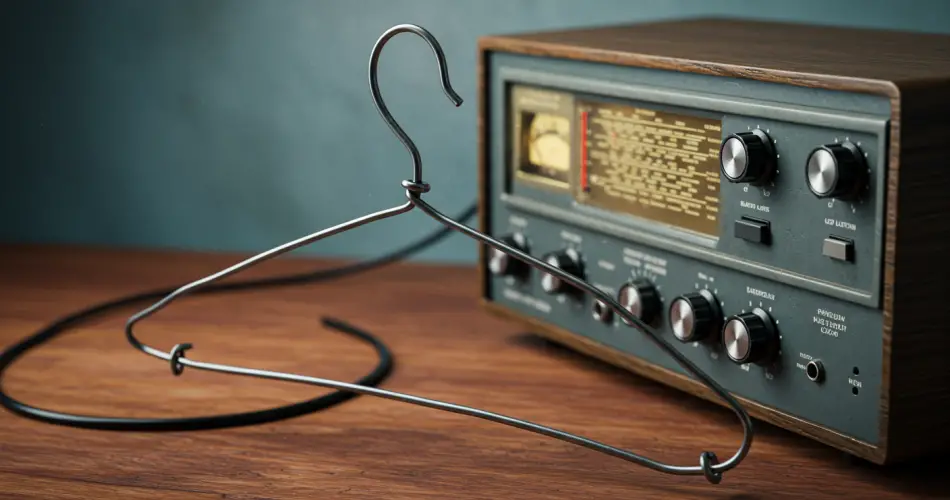
One of the simplest and most popular DIY antenna hacks involves using a metal clothes hanger and a coaxial cable. While it won’t outperform a high-quality commercial antenna, it can provide adequate reception in many situations at virtually no cost.
Materials You’ll Need
-
A metal clothes hanger
-
A length of coaxial cable (length depends on where you’ll place the antenna)
-
A male coaxial connector
-
Electrical insulating tape
-
A screwdriver
-
A utility knife or cutter
Step-by-Step Instructions
-
Prepare the coaxial cable
Start by removing the female coaxial connector from one end of the cable. Using the utility knife, carefully strip about 10 centimeters of the outer plastic sheath to expose the inner shielding. -
Attach the cable to the hanger
Straighten the hanger if needed, then wrap the exposed portion of the coaxial cable around it. Position the cable so that the bare section sits at the bottom of the hanger frame. Use electrical tape to hold it firmly in place. -
Expose the inner conductor
Gently pull back the outer insulation and shielding to reveal the inner dielectric and copper conductor. This will help establish better contact between the cable and the hanger. -
Secure the connection
Make a small incision in the sheath if necessary and continue wrapping the coaxial cable around the hanger without breaking the wire’s continuity. Fix everything in place with electrical tape to prevent loosening. -
Add the coaxial connector
Attach the male coaxial connector to the free end of the cable. Tighten it securely with the screwdriver. -
Position your DIY antenna
Hang the wire hanger on a curtain rod or place it near a window where reception is strongest. The higher and more unobstructed the location, the better. -
Connect to your TV
Insert the male coaxial connector into your television’s antenna input. -
Fine-tune the direction
Slowly rotate or reposition the hanger until you achieve the best possible reception. Experiment with angles, as even slight adjustments can make a significant difference.
How Well Does It Work?
The effectiveness of this DIY antenna depends on your location and signal strength in your area. For urban apartments close to transmitters, it can often capture multiple channels with clarity. In rural areas, it may struggle with long distances, but it can still provide access to at least some local broadcasts.
The hanger method is particularly useful in emergencies—such as when your main antenna fails, or when you move into a new place and need a temporary setup.
Tips for Better Results
-
Place the antenna as high as possible, ideally near a window facing the direction of the broadcast tower.
-
Keep it away from large electronic devices that may cause interference.
-
Consider adding a signal amplifier if you’re in a weak reception area.
-
Experiment with different hanger shapes—sometimes adjusting the form can improve reception.
Conclusion
Television antennas remain a crucial tool for accessing free-to-air broadcasts, especially in areas where streaming or cable isn’t an option. While professional antennas are still the most reliable solution, a simple DIY alternative like the wire hanger antenna proves that you don’t always need expensive equipment to stay connected.
With just a hanger, a coaxial cable, and a few basic tools, you can craft a functional TV antenna in minutes. It’s an affordable, practical solution that combines creativity with utility—perfect for those who love DIY projects or simply need a quick fix for better reception.