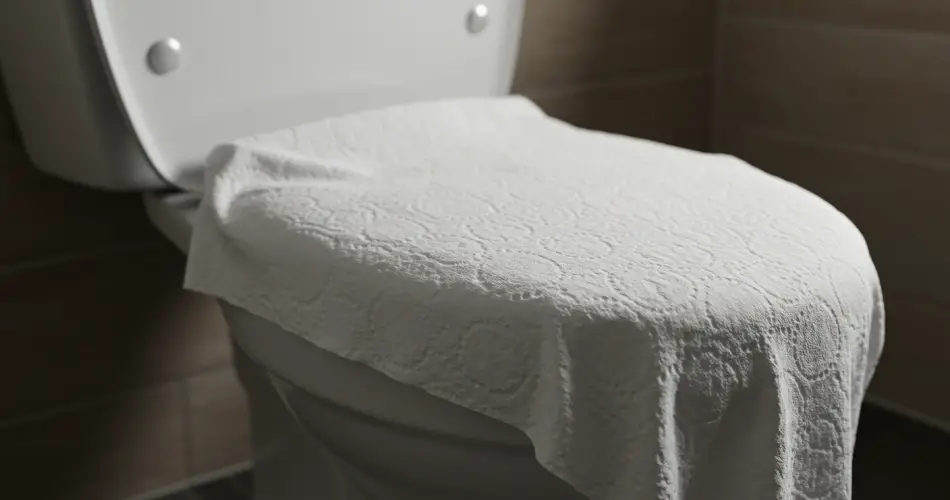

We’ve all faced it: needing to use a public restroom and instinctively reaching for the toilet paper to cover the seat before sitting down. It feels like a clever, hygienic solution, right? In truth, placing toilet paper on a public toilet seat might be one of the least effective—and potentially counterproductive—methods to protect yourself from germs. Let’s unpack why this common habit doesn’t do what we think it does and what you should do instead.
The Habit of Covering the Seat
This scenario is particularly familiar to women, who often have no choice but to sit to use the toilet. The thought of sitting directly on a public toilet seat, especially one that countless people have used before, can feel deeply unhygienic. Many of us imagine an invisible army of germs, bacteria, and viruses lurking on the surface. Understandably, the instinctive reaction is to create a “barrier” with toilet paper.
For many, this method feels safer than hovering in a half-squat, balancing precariously over the bowl while juggling bags or clothing. When faced with an unusually high toilet or a cramped stall, maintaining that position becomes nearly impossible. So, people opt for what seems like the next best thing: a few sheets of paper on the seat.
However, despite its popularity, this strategy is not only ineffective—it can make the situation worse.
Why Toilet Paper Doesn’t Protect You
At first glance, toilet paper seems like an obvious barrier. But when we understand how it’s made and what it’s designed for, it becomes clear why it fails as protection. Toilet paper is made of cellulose fibers specifically engineered to absorb moisture and particles. Its purpose is to collect and remove waste—not to shield you from it.
Because of this, instead of blocking bacteria, the paper can actually attract and retain germs from the seat’s surface. When you sit down, the paper may act as a bridge, transferring microbes directly to your skin. So rather than functioning as a protective layer, it can behave like a germ conductor.
And that’s not the only problem. Think about where the toilet paper in public restrooms is stored. Rolls are often kept right beside or above the toilet bowl—sometimes in open holders. Every time a toilet is flushed with the lid up, microscopic droplets containing bacteria and viruses are released into the air in what’s known as a “toilet plume.” These particles can settle on nearby surfaces—including the very toilet paper you plan to use as your barrier.
So, when you place those sheets on the seat, you might actually be using paper that’s already contaminated with airborne germs. Ironically, your well-intentioned effort to stay clean can expose you to more bacteria than if you had simply sat down.
The Reality About Public Toilet Seats
It may be surprising, but public toilet seats are not the hotbeds of infection many people imagine. Numerous studies have shown that smooth, dry surfaces like toilet seats harbor far fewer pathogens than you’d think. Germs need moisture and organic material to thrive, and toilet seats—especially those made of plastic—are typically poor environments for microbial growth.
In other words, the risk of contracting infections from simply sitting on a relatively clean seat is very low. Skin is also an effective barrier, and most germs that linger on the seat cannot penetrate it. The danger increases only when there are open wounds or if the seat is visibly dirty, covered with bodily fluids, or in disrepair.
Better Alternatives to the Toilet Paper Method
If the idea of sitting on a public toilet still makes you uneasy, there are safer and more effective ways to protect yourself.
1. Use disposable toilet seat covers.
Many public restrooms now provide thin, specially designed seat covers made of treated paper. These covers create a genuine hygienic barrier between you and the toilet seat. They’re also designed to be flushed afterward, minimizing waste and contamination. If you use public bathrooms frequently, you can carry your own travel pack—small, light, and easy to keep in a purse or bag.
2. Sanitize the seat before sitting.
A growing number of people carry small bottles of hand sanitizer or antibacterial wipes, a habit that became widespread during the COVID-19 pandemic. These items are incredibly handy in public bathrooms. Simply apply a bit of sanitizer or wipe the seat down thoroughly before using it. This not only removes germs but also gives you peace of mind knowing the surface is freshly cleaned.
3. Keep personal tissues or wipes on hand.
Because toilet paper in public bathrooms can easily be contaminated, it’s smart to carry a small pack of personal tissues or wet wipes. These are useful not only for cleaning the seat but also as a safer option for personal hygiene if the supplied paper looks questionable.
4. Avoid touching unnecessary surfaces.
Use your elbow, tissue, or foot to operate flush handles, door locks, and faucets whenever possible. Washing your hands properly afterward remains the most effective step to avoid germs.
When It’s Best Not to Sit
Of course, not every restroom is equal. If the toilet seat is visibl